
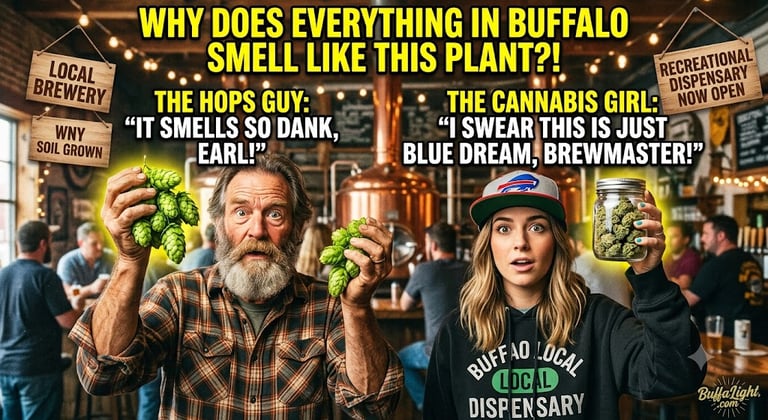
Cousins of the Conifer: Why Hops and Hemp Smell So Much Alike 🌲🍻
Have you ever cracked open a fresh, hazy IPA from a craft brewery in the City of Buffalo, taken a deep breath, and thought, “Wow, that smells exactly like a fresh bag of bud”?
🤔You aren't imagining things, and it isn't a coincidence!🤔
As legal adult-use marijuana dispensaries continue to open their doors across WNY towns and villages—from Amherst and Williamsville to Hamburg and East Aurora—Western New York cannabis enthusiasts are waking up to a fascinating botanical reality. The sticky hops that give our local beers their legendary punch and the premium THC or CBD flower found at your local dispensary are actually long-lost evolutionary cousins. 🌿✨
Let's take a deep, educational dive into the secret botanical relationship between Humulus lupulus (hops) and Cannabis sativa, and find out why their aromatic paths are deeply intertwined.
🧬 Family Reunion: Welcome to the Cannabaceae Clan
If you put a dense, resinous cannabis bud right next to a vibrant green hop cone, the physical resemblances are striking. They both sport intricate, layered green structures, they both feel incredibly sticky to the touch, and they both exude an intensely pungent, unmistakable aroma.
This isn't just a surface-level lookalike situation—it’s a genetic reality! Both hops and cannabis belong to the exact same evolutionary plant family: Cannabaceae. 🌳
Centuries ago, these plants shared a common ancestor. Over time, hops evolved into climbing vines that thrive on trellises (producing the bitter cones used to balance sweet malt in beer), while cannabis evolved into a versatile annual herb prized for its cannabinoid-rich trichomes. When you visit a Western New York dispensary for recreational use or medical use products, you are literally purchasing the evolutionary sibling of the hops being brewed down the street in the classic industrial districts of Buffalo.
🧪 The Terpene Translator: The Shared Aromas of WNY Soil
The reason these two plants smell so incredibly similar comes down to terpenes—the organic, aromatic hydrocarbons produced in the resin glands of both species. When local cannabis cultivators harvest a crop grown in rich WNY soil, or when a brewmaster adds a fresh batch of hops to a boiling kettle, they are manipulating the exact same chemical compounds.
Two major terpenes bridge the gap between your favorite local pint and your preferred pre-roll:
Humulene 🪵: This terpene was actually named directly after hops (Humulus lupulus) because it is found in such massive concentrations within them. Humulene gives off a distinct woody, earthy, and refreshing "beer garden" aroma. It’s the compound responsible for that crisp, forest-like smell you get when cracking open a locally brewed pale ale, and it provides a deeply grounding, anti-inflammatory experience in many hybrid and indica marijuana strains.
Caryophyllene 🌶️: This is a spicy, peppery terpene that functions uniquely because it can directly interact with the body's endocannabinoid system. In the beer world, caryophyllene is what gives complex Belgian ales or heavily dry-hoed IPAs their subtle, spicy kick. In cannabis, it adds a rich, peppery bite to the flavor profile, often associated with strains that offer powerful stress relief and physical comfort.
🍺 The Brewing Analogy: Understanding the "Entourage Effect"
In the cannabis community, people frequently talk about the entourage effect—the scientific theory that cannabinoids like THC and CBD work synergistically with terpenes to create a whole greater than the sum of its parts. If you are new to exploring recreational use dispensaries, this concept can feel a bit abstract.
Thankfully, as Western New Yorkers, we already have the perfect analogy built right into our culture: The Anatomy of a Beer. 🍻
Think of malt as the THC of the brewing world. Malt provides the sugars, which ferment into alcohol, giving a beer its strength, baseline potency, and "buzz." However, if you brewed a beer with only malt, it would be a sweet, boring, one-dimensional sugar-bomb.
That is where hops come in! Hops don't add to the alcohol percentage, but they give the beer its entire character, its aroma, its bitterness, and its unique style—transforming it into a West Coast IPA, a Belgian Wit, or a robust Stout.
In the exact same way, THC provides the potency, but terpenes provide the vibe and direction of the cannabis experience. A high THC percentage alone just gives you a baseline intoxication. It is the humulene, caryophyllene, and other terpenes that dictate whether a strain makes you feel creatively energized, blissfully relaxed, or completely ready for bed. 🛌✨
🦬 Why Western New York is Such a Special Place Right Now
We are living in an incredibly unique moment in Buffalo's history. For decades, our region has perfected the art of craft fermentation, building a world-class reputation for local brewing excellence. Now, with safe, tested, and legal cannabis readily available at licensed Western New York dispensaries, our local flavor culture is doubling in size.
Whether you are utilizing cannabis for a certified medical use condition or exploring the legal market for weekend relaxation, we have access to an unprecedented bounty of artisanal craftsmanship. Buffalonians have always had an incredible palate for bold flavor and authentic, soil-to-shelf products. Having the best of both the craft beer and craft cannabis worlds right in our backyard makes the Queen City an absolute paradise for flavor connoisseurs! 🎉
hello@buffalight.com
© 2026. All rights reserved.